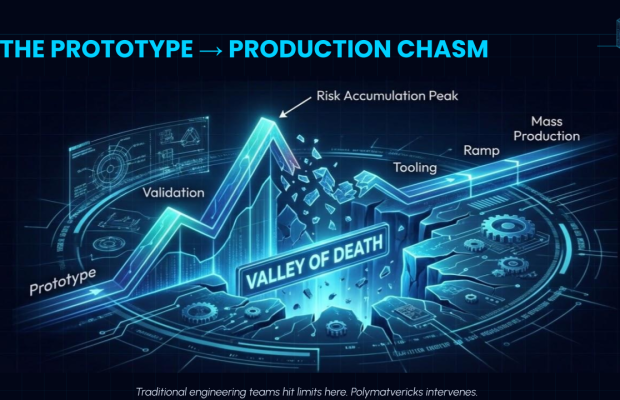
Don't Let the "Valley of Death" Kill Your Product
We help robotics and advanced hardware companies scale from prototype to production without structural failure.
The Industry Problem
A working prototype proves possibilities. Production tests whether the full system can hold.
Production exposes weaknesses that prototypes conceal:
- Architecture fragility under production load
- Sim2Real gaps between simulation and field performance
- Quality and Compliance blind spots
- Manufacturing and Supply Chain instability
- Operating Model misalignment across teams
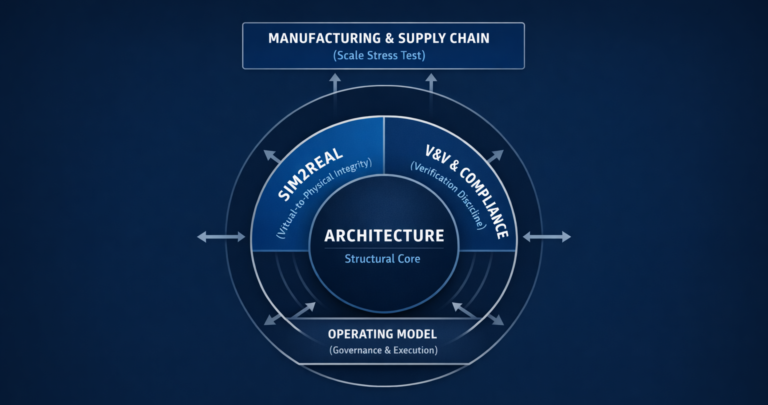
The Polymatvericks Five-Pillar Scale Integrity Model
We assess capability and connected scale exposure across Architecture, Sim2Real, V&V & Compliance, Manufacturing & Supply Chain, and Operating Model.
Architecture
System integrity under scale.
Sim2Real
Model-to-reality alignment.
V&V & Compliance
Validation governance.
Manufacturing & Supply Chain
Production stability.
Operating Model
Execution governance.
Bridging Agile Velocity and Safety-Critical Rigor
Polymatvericks’ operating model discipline was shaped at the intersection of software-velocity environments, safety-critical aerospace systems, and production-scale manufacturing.
We integrate gaming-grade iteration speed, aerospace systems rigor, and OEM and Contract manufacturing realities into a unified governance framework for hardware scale.
Meet the Bridge Builder
Chioma Aso’s career spans safety-critical engineering at Lockheed Martin, software velocity at Electronic Arts, and production-scale manufacturing at Jabil and Watchfire Signs.
The intersection of aerospace rigor, gaming-grade iteration, and both CM and OEM manufacturing reality, is the foundation the Polymatvericks framework was built on.
Engagement Methodology
Phase 1
Independent Scale Audit
We examine the five pillars, investigate connected consequences, and
identify the decisions that matter before expansion.
Standalone assessment. Required before Phase II implementation.

Phase 2
Targeted Implementation
We work alongside your team to implement audit findings and strengthen capability across the pillars.
Collaborative implementation.
Minimum 90-day engagement.

Phase 3
Strategic Oversight
We provide milestone oversight, evidence review, and decision escalation as your team carries the implementation plan forward.
Optional time-limited engagement.
Up to 90 days engagement.
Strategic Advisory
Independent judgment for your next engineering or scale decision. Work with an experienced adviser who connects the five pillars, examines the evidence and tradeoffs, and recommends a path within the reviewed scope.
Prototype-to-MVP Readiness -Phase 0
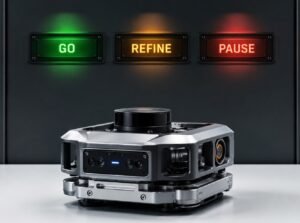
Have a prototype but need a clearer MVP direction? Our Prototype-to-MVP Readiness Review identifies consequential assumptions, priority gaps, and what should be proven before deeper investment.
A focused Phase 0 review with a Go / Refine / Pause recommendation.
What you gain from working with us
Each engagement is designed to leave your organization structurally stronger and better informed.
Scale Readiness Visibility
Understand what the evidence supports, where capability gaps remain, and which conditions matter before increasing production or deployment.
Decision Clarity for Boards & Investors
Receive findings, implications, and recommended actions that connect engineering evidence to leadership decisions. Capital deployment becomes deliberate, not reactive.
Cross-Functional Engineering Cohesion
Identify dependencies across teams so changes and decisions can be coordinated.
Supply Chain Resilience
Understand consequential supplier dependencies, continuity assumptions, and the evidence supporting the proposed production ramp to enable anticipating and managing disruptions rather than absorbed at scale.
Governance for Human-Machine Workflows
The operational interfaces between people and systems get structure. Nothing is left to assumption. Workflows that appeared functional at prototype scale hold up under production pressure.
Risk-Based Execution Prioritization
Your team stops reacting and starts sequencing. Engineering effort is directed toward the highest-leverage risks, not the loudest ones.
A Clear Basis for the Next Decision
Know where the assessed configuration stands, which uncertainty remains, and what would require renewed review. The result: a stronger organization with a clearer basis for production scale.
Scale Without Structural Failure
Scale exposes weakness.
Structure prevents it.
We build the systems that allow products to scale.