
The System Doesn’t End at the Machine
We often draw a robotic system’s boundary around the machine. We treat the hardware, software, sensors, controls, instruments, and interfaces as the system. We place the people who operate it, the procedures they follow, and the organization responsible for its use outside that boundary, and we label it training, operations, or management. While that may be convenient, it is not always technically honest.
If safe operation depends on someone recognizing a condition, receiving the right information, exercising authority, and acting within the available time, that decision path is part of the system. It is no longer simply training, operations, or management. It becomes part of the system’s Decision Architecture. This is where the Operating Model becomes more than an organizational concern.
Decision Architecture is the structure through which evidence, authority, and action move when a consequential decision must be made. It reveals who owns the decision, how risks escalate, which teams must coordinate, and how competing priorities become action under pressure.
The machine is only one participant
In September 2026, the U.S. Food and Drug Administration issued draft guidance for premarket submissions involving certain robotically assisted surgical devices. The guidance reaches well beyond robotic movement. It addresses controls, fault response, emergency removal, instruments, accessories, software, reliability, human factors, training, sterility, and reprocessing. It also considers realistic use involving representative users and teams working together as they would in an operating room.
Polymatvericks is viewing this through the Decision Architecture lens because the broader implications matter: the machine is not the only factor in the outcome. Safe operation depends on how the entire arrangement works together.
A surgeon operates the system while other members of the surgical team work near the patient, exchange instruments, manage supporting equipment, and respond to changing conditions. The robot interacts with cameras, displays, accessories, energy sources, and other devices. But the technical interfaces are only part of the system.
If safe operation depends on someone recognizing a condition, receiving the right information, exercising authority, and acting within the available time, that decision path is part of the system. It is no longer simply training, operations, or management. It becomes part of the system’s Decision Architecture. This is where the Operating Model becomes more than an organizational concern.
Decision Architecture is the structure through which evidence, authority, and action move when a consequential decision must be made. It reveals who owns the decision, how risks escalate, which teams must coordinate, and how competing priorities become action under pressure.
Proximity can hide an undefined operating dependency
Imagine a robotic system entering an early hospital pilot. The development team is nearby. An engineer is present during the first procedures. When an unfamiliar warning appears, the surgical team looks toward the engineer. The engineer recognizes the condition, provides context, and helps the team decide what to do. The procedure continues safely.
The company may interpret that result as evidence that the operating model works. But the pilot may have demonstrated something narrower: The system works when the person carrying the missing knowledge and authority is standing nearby. Proximity has compensated for an undefined dependency.
When the company scales, the engineer cannot remain inside every operating room. Training, procedures, and support channels will replace proximity to the engineer. Training can show the team where an emergency control is located and explain how it functions. But it may not answer the harder question:
Who is authorized to use it when the situation is ambiguous and interrupting the operation is costly?
Consider a $50,000 procedure already in progress. A member of the surgical team recognizes an abnormal condition and can physically access a control that can halt the robot. The intervention mechanism works. The person knows how to use it, but they are uncertain whether they have the authority to interrupt the surgeon, stop the procedure, or initiate an emergency transition.
In this scenario, the technical interface works. The authority interface does not.
When the operating model never clearly establishes who can make the decision under pressure, hesitation will follow regardless of the team’s training.
Decision Architecture
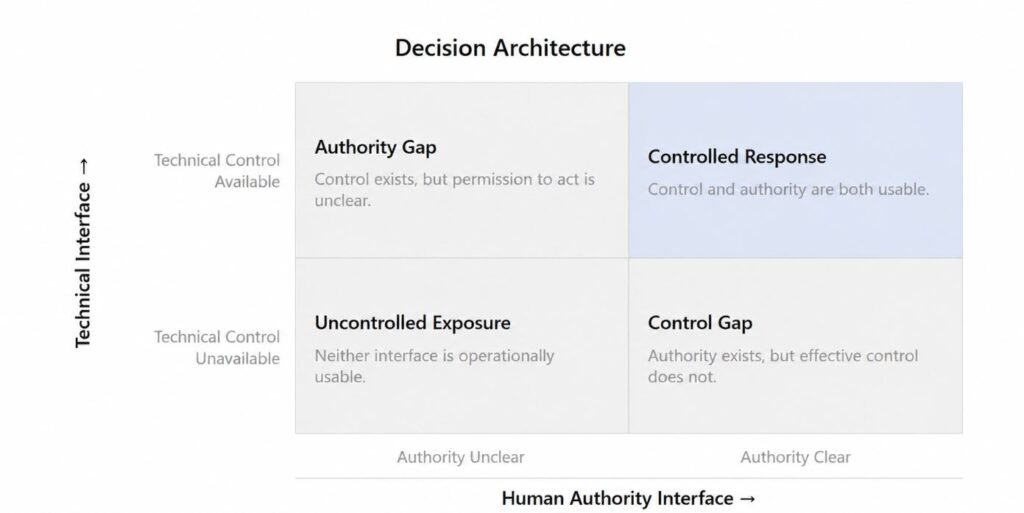
Decision Architecture Matrix
Y-axis: Technical Interface
- Technical Control Available
- Technical Control Unavailable
X-axis: Human Authority Interface
- Authority Unclear
- Authority Clear
The distinction matters because a functioning technical control does not automatically create a functioning decision path.
The same failure on the factory floor
Now consider an industrial robot moving outside its expected boundary. The line manager and safety specialist both recognize the condition. The emergency control is functional. The line manager assumes the safety specialist has authority to stop production. The safety specialist assumes the line manager must approve the interruption because the line is losing $10,000 for every minute it remains stopped.
Both people see the risk. Both know intervention is technically possible. Neither believes the decision is theirs; therefore, the robot continues operating. This is not simply a communication problem. It is a structural weakness in how the organization coordinates decisions.
The same pattern can appear in a warehouse, autonomous laboratory, field robot, or defense system. The product may have the required technical controls, but the surrounding organization cannot produce an authorized response quickly enough to use them.
Fast Decisions Slow Organization
Engineers already understand latency. A signal is generated. It moves through an interface. It is processed. A command is issued. The system responds.
Organizations also have latency. A condition becomes detectable. Someone must recognize its significance, gather or locate the relevant evidence, route it to the right person, resolve competing interpretations, exercise authority, and initiate the response. This is where two related ideas become useful.
Decision latency is the time between actionable evidence reaching the authorized decision owner and the selected response being initiated.
Organizational latency begins earlier. It starts when the condition becomes detectable within the operating system and continues until an authorized response is initiated.
Decision latency may be short, while organizational latency can be dangerously long.
The owner may decide within thirty seconds of receiving the evidence. But if it took ten minutes for the warning to be recognized, interpreted, escalated, and put in front of that owner, the organization didn’t respond in thirty seconds. It responded in ten and a half minutes. And in that environment, consequences won’t wait for the organizational chart to catch up.
If a field robot will enter an unsafe condition in thirty seconds, an escalation path that takes three minutes is incompatible with the dynamics of the system it governs. If a production line can keep producing suspect units while teams debate ownership, every minute of uncertainty worsens the containment problem. If an operating-room team must act immediately but authority becomes clear only after consultation with someone outside the room, the intervention mechanism may exist without a usable decision path.
We are not trying to reduce organizational behavior to a formula. The goal is to recognize that the movement of evidence, authority, and action has its own system behavior.
A successful pilot may validate the wrong system
This is one of the more dangerous scale-readiness traps. A pilot can succeed because the system is surrounded by extraordinary support:
- The engineers who built it are nearby.
- Senior leaders are personally monitoring the deployment.
- Unusual conditions receive immediate attention.
- Decisions bypass the normal organization.
- The people involved share knowledge that has never been documented or transferred.
The company may see a functioning product, but what it may actually have is a functioning product inside a temporary operating model that cannot scale.
When the product scales, the organization must reproduce what proximity was doing. It must reproduce access to evidence, interpretation, authority, cross-team coordination, and the ability to act before consequences develop.
If it cannot, the pilot did not validate the system that will exist at scale.
The Operating Model Pillar gap is easy to miss
A system can have technical controls, a procedure, a training record, and an escalation chart. Each item may appear complete when reviewed separately. The gaps become visible only when we ask whether they can work together under pressure.
- Can the person who detects the condition reach the person who understands it?
- Can the person who understands it reach someone authorized to act?
- Do the affected teams share the same priorities and decision criteria?
- Can disagreement be resolved before delays change the consequences?
- Does the decision translate into coordinated action?
- Will the same arrangement still work across more sites, users, shifts, and operating conditions?
These questions are not concerned with the organization chart or company culture. They ask whether the organization can coordinate decisions under production or deployment pressure.
That is the core question of the Operating Model pillar.
The system boundary must follow the dependency
The Polymatvericks 5-Pillar Scale Integrity Model examines five domains where scale risk accumulates as systems transition from prototype to production.
Architecture — System integrity under scale. Can the architecture scale without redesign?
Sim2Real — Model-to-reality alignment. Do the models accurately match real-world behavior?
V&V & Compliance — Validation governance. Can the system be shown to meet requirements and regulatory standards?
Manufacturing & Supply Chain — Production stability. Can the product be built repeatedly at production scale?
Operating Model — Execution governance. Can the organization coordinate decisions under production pressure?
In this article, we examine that final question more closely. Decision Architecture gives us a way to see that coordination.
A robotic system may contain every technical mechanism required to respond to a fault. But those mechanisms are effective only if the condition is recognized, evidence reaches the right people, authority is understood, and action begins within the time the system allows. That pathway is not administrative overhead. It is part of the engineered system.
The real system boundary does not end where the hardware ends. It ends where the dependencies end.
Disclaimer: This article is provided for general informational purposes only and does not constitute engineering, regulatory, legal, compliance, or other professional advice. References to external organizations, publications, products, or services do not imply endorsement or affiliation. Readers should evaluate requirements and risks based on their specific product, market, and circumstances.