SCALE-UP AUDIT FRAMEWORK
Our proprietary framework for quantifying hardware and robotics scale readiness.
The Polymatvericks 5-Pillar Scale Integrity Model
The Polymatvericks Scale Integrity Model evaluates five domains where scale risk accumulates as robotics and hardware systems transition from prototype to production.
Each domain examines a key question about structural readiness for production scale.
Architecture
System integrity under scale.
Ensuring structural robustness and disciplined system design before production load amplifies hidden weaknesses.
Key Question
Can the architecture scale without redesign?
Sim2Real
Model-to-reality alignment.
Ensuring modeled performance translates reliably into real-world deployment environments.
Key Question
Do the models accurately match real-world behavior?
V&V & Compliance
Validation governance.
Ensuring verification discipline, regulatory readiness, and controlled risk exposure before scale.
Key Question
Can the system be shown to meet requirements and regulatory standards?
Manufacturing & Supply Chain
Production stability.
Ensuring supply resilience and operational continuity during production ramp.
Key Question
Can the product be built repeatedly at production scale?
Operating Model
Execution governance.
Ensuring leadership alignment, decision cadence, and cross-functional clarity under production pressure.
Key Question
Can the organization coordinate decisions under production pressure?
How Scale Applies Stress Across These Domains
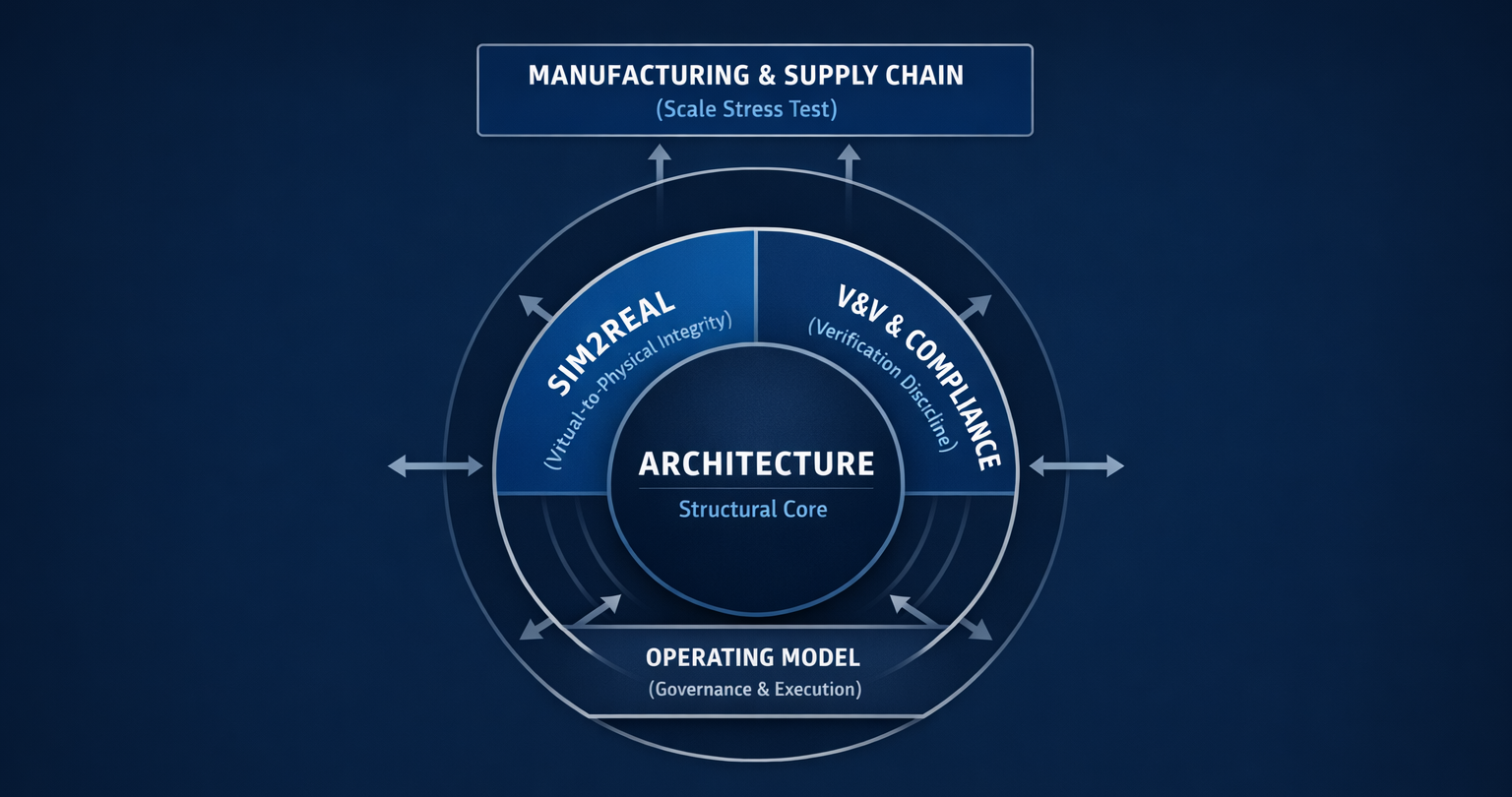
The five pillars define the structural domains of the operating model.
This diagram illustrates how production scale applies stress across those domains, revealing where strain accumulates during the transition from prototype to production.
Architecture — Structural Core
Architecture sits at the center. It is the technical foundation that must withstand production load without fundamental redesign. Structural integrity, modularity, and technical debt determine whether scale is sustainable.
Sim2Real & V&V & Compliance — Validation Discipline
Surrounding the core is validation. Simulation fidelity, verification loops, and compliance rigor ensure that digital performance translates reliably into physical deployment.
Manufacturing & Supply Chain — External Scale Stress
Production ramp introduces external force. Supply stability, repeatability, and factory alignment test whether design intent survives real-world constraints.
Operating Model — Governance & Execution
Execution governs all layers. Decision rights, engineering cadence, and cross-functional alignment determine whether structural coherence holds under increasing complexity.
What Scale Reveals
A company enters validation with an architecture optimized for rapid software iteration. Simulation results are strong. Feature velocity is high. Confidence builds around digital performance.
As physical integration begins, fidelity gaps surface. Hardware constraints introduce latency and performance ceilings that were not fully modeled. Software continues iterating against simulation outputs that no longer reflect production reality.
Integration cycles lengthen.
At the same time, manufacturing commitments advance, tooling is approved, suppliers are engaged, capital is allocated based on projected stability.
Desynchronization emerges.
Hardware revision timelines extend. Software cadence remains aggressive. Validation tightens under compliance pressure. Escalation pathways blur across engineering and program leadership.
What appears to be a hardware–software misalignment is structurally rooted in three domains:
- Architectural rigidity limiting modular correction
- Validation gaps between simulation and physical deployment
- Operating discipline breakdown in cadence governance
By the time the strain is recognized, production commitments have made the correction expensive.
Scaling is a structural stress test.
Production ramp introduces systemic friction that many organizations only recognize once capital and timelines are already committed.
The stress behavior is not a checklist. It illustrate how strain accumulates under load as a company transitions from prototype to production.
Scale Without Structural Failure
Scale exposes weakness.
Structure prevents it.
We build the systems that allow products to scale.