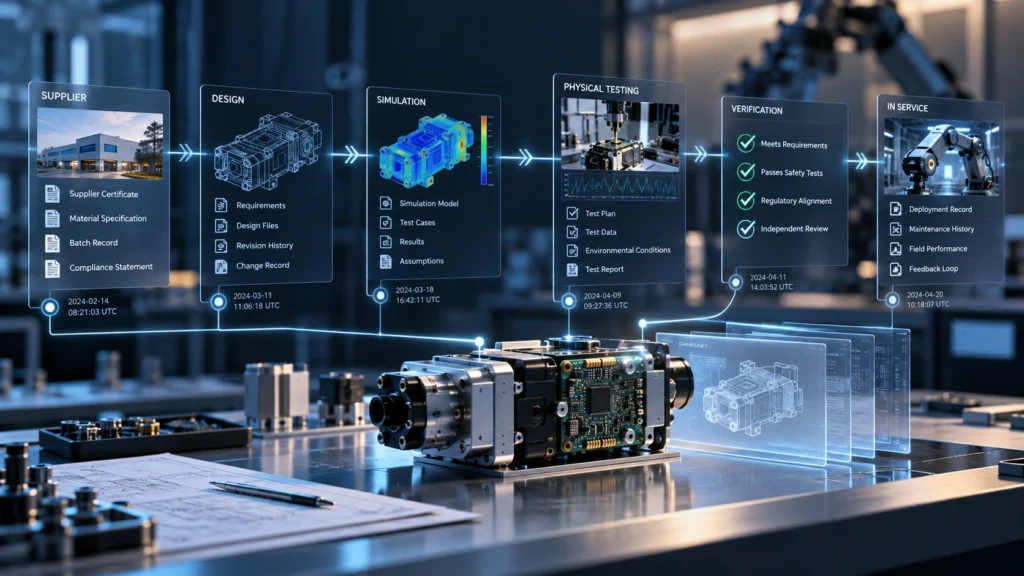
Scale-readiness evidence is becoming inseparable from provenance—the pedigree of components, models, data, simulations, suppliers, and regulatory claims.
In robotics and advanced hardware, proof of function is not proof of scale. A prototype may work perfectly in a controlled environment, but as the system moves toward production, a structural shift occurs. The evidence supporting the product’s readiness becomes completely dependent on its provenance.
When the origin of your hardware, the fidelity of your simulation, or the lineage of your data is weak, the system’s foundation fractures under production pressure. Here is why the pedigree of your evidence dictates your ability to scale.
The Cascade Effect of Component Substitution
The supply chain for advanced electronics is inherently volatile. Cost pressures, limited availability, and extended lead times are permanent realities for hardware manufacturers. However, for robotics and advanced hardware companies, component availability is far more than a procurement issue.
When a component becomes unavailable and forces a pivot, the replacement can fundamentally alter the system architecture. It can break firmware compatibility, invalidate prior testing, void regulatory evidence, alter manufacturing processes, and derail production schedules. A component substitution may begin as a supply-chain decision, but it quickly cascades across the entire engineered system.
Origin Dictates Market Access
Regulatory bodies globally are increasing their scrutiny over where advanced robotic devices and their subsystems are manufactured. Market access is increasingly dictated by technology origin and the affiliated entities sitting behind a supplier.
For companies building on third-party robotic platforms or sourcing global components, provenance can no longer be treated as a purchasing detail. It directly dictates cybersecurity exposure, regulatory authorization, customer eligibility, access to replacement parts, and the viability of the product’s current architecture. A technically functional system will still fail a scale-readiness test if its commercial path depends on hardware or suppliers whose regulatory eligibility is uncertain.
The Fidelity of Simulation Evidence
As robotics teams rely more heavily on learned models, synthetic environments, and generative world models, simulation evidence is being held to a much higher standard. While simulated testing accelerates development, deep analysis of generative world models routinely exposes significant gaps in physical correctness, closed-loop evaluation, long-term consistency, and real-world transfer.
This does not mean world models have no value. It means a convincing simulated result cannot automatically be treated as evidence that a physical system will perform the same way. The useful question is not, “Did we simulate it?” The question is:Did the representation of reality have sufficient fidelity for the decision we made based on it?
The ultimate scale trap is validating a design under clean, synthetic assumptions, only to discover later that physical variance creates instability in the field. Teams must understand exactly what their simulation evidence can and cannot support.
The Underlying Question
Each of these challenges poses the same fundamental question to engineering leadership:
Can the company establish where its evidence came from, which assumptions it depends on, and what changes would invalidate it?
A supplier assurance, test result, simulation output, compliance determination, or component qualification may be entirely valid upon creation. But production introduces substitutions, revisions, new operating conditions, different suppliers, and changing regulatory criteria.
If the evidence cannot be dynamically linked to the current product configuration and its production path, the company may have proof that a past version worked, but not that the current system is ready to scale.
This is the exact structural risk Polymatvericks examines across its Five-Pillar Scale Integrity Model. An individual change may appear small, but the scale-readiness consequence rarely stays in one place.
Disclaimer: This article is provided for general informational purposes only and does not constitute engineering, regulatory, legal, compliance, or other professional advice. References to external organizations, publications, products, or services do not imply endorsement or affiliation. Readers should evaluate requirements and risks based on their specific product, market, and circumstances.