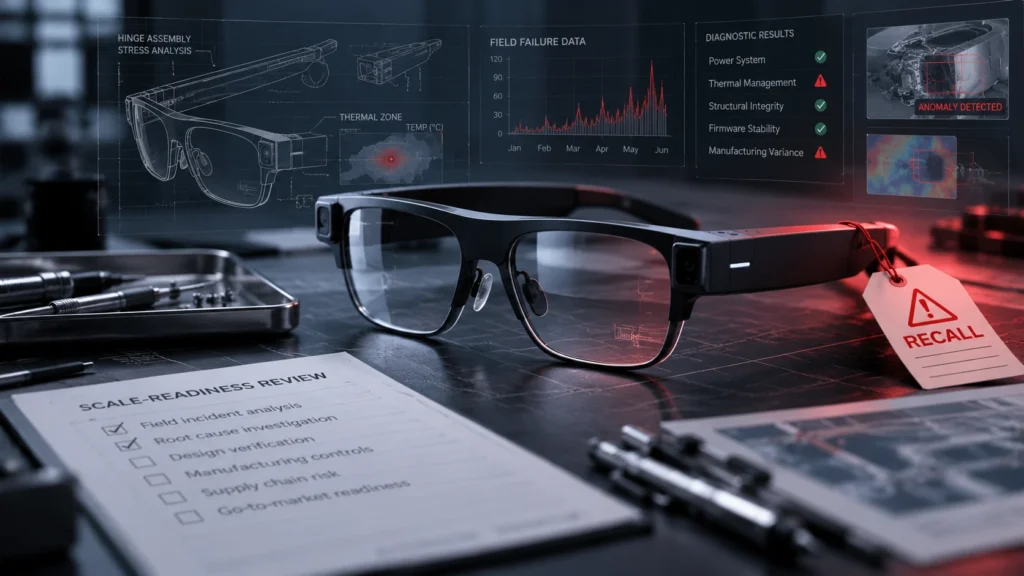
According to the recall notice, the left temple can overheat during extended use, creating a burn hazard. The company received ten reports of overheating, including reports of burning sensations to users’ faces and ears. Consumers were instructed to stop using the glasses and contact INMO for a repair involving an update to system version V3.16.
The public notice does not identify the technical cause of the overheating, and in this article we are not assuming one. But the field outcome raises an important scale-readiness question:
What evidence supported the decision to ship the product for extended use?
A familiar scale-risk pattern
When we built the Polymatvericks Scale Integrity Simulator, one of our fictional scenarios involved a mobile inspection robot that performed successfully during five-minute demonstrations but overheated during a 45-minute continuous-duty cycle.
The scenario was designed to demonstrate a broader risk pattern: a product can work under nominal or short-duration conditions while an unverified operating condition remains hidden until the system reaches the field.
The simulator asked the user to make a decision under pressure. One option was the Polymatvericks Readiness Gate: pause the pilot, reproduce the sustained operating condition, instrument the thermal paths, define the acceptance criteria and qualify the revision before release.
That option introduced an immediate delay. But it prevented an unresolved condition from being transferred into the customer environment. The Readiness Gate did not assume the cause of the problem. It created the evidence needed to make the next decision.
What could an earlier scale-readiness audit have examined?
A Polymatvericks Independent Scale Audit conducted before shipment would not begin by claiming to know what could fail. It would examine whether the evidence supporting release was strong enough for the way the product was expected to be used.
For a wearable, battery-powered and compute-dense product, using the 5-pillar Scale Integrity model, the review could ask:
Did thermal validation represent sustained use rather than only nominal or shorter-duration operation? (Sim2Real)
Did the test conditions reflect the workloads, ambient conditions and product configurations customers could encounter? (Sim2Real)
Were thermal acceptance criteria and operating limits defined before release? (Verification, Validation & Compliance)
Could production variation or component substitutions affect the available thermal margin? (Manufacturing & Supply Chain)
If firmware performed a safety-related function, was that dependency identified and verified? (Architecture)
Who had authority to determine that the available evidence was sufficient for shipment? (Operating Model)
Which assumptions remained unresolved, and what conditions would require the release decision to be reconsidered? (Operating Model)
These questions would not guarantee that every failure would be predicted. As we have always stated, scale readiness is not zero uncertainty. The purpose is to make consequential assumptions visible while the company can still decide what to do about them.
When the field becomes part of discovery
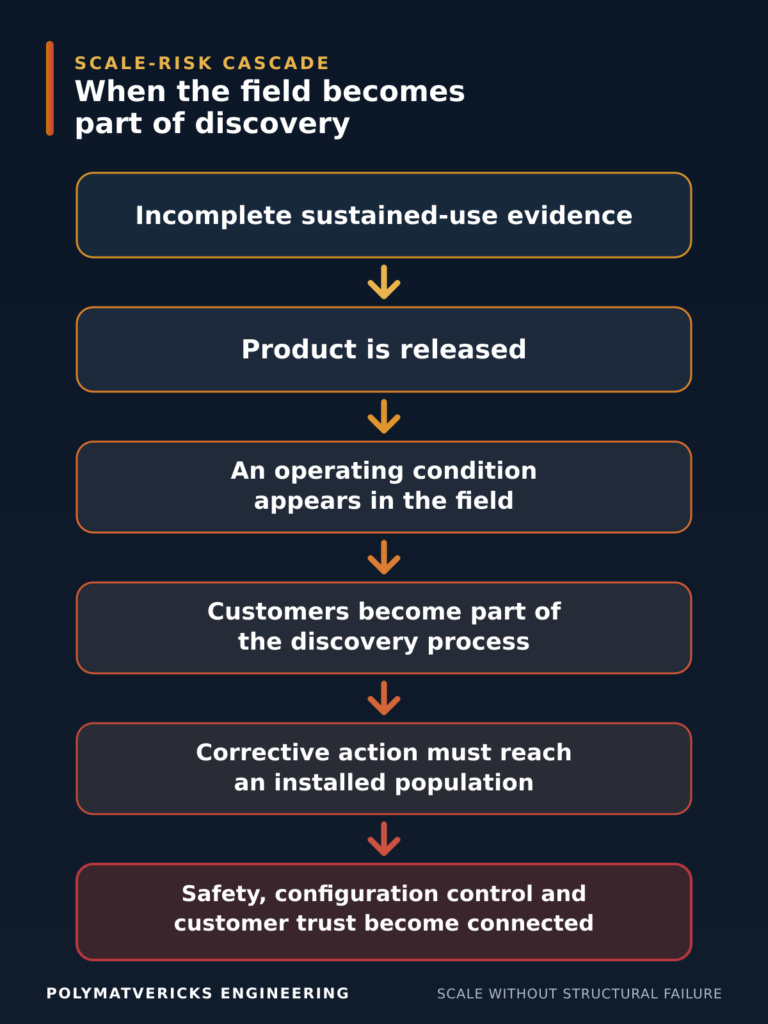
Without an earlier evidence gate, the cascade can look like this:
Incomplete sustained-use evidence → product is released → an operating condition appears in the field → customers become part of the discovery process → corrective action must reach an installed population → safety, configuration control and customer trust become connected.
Polymatvericks Field Discovery Cascade
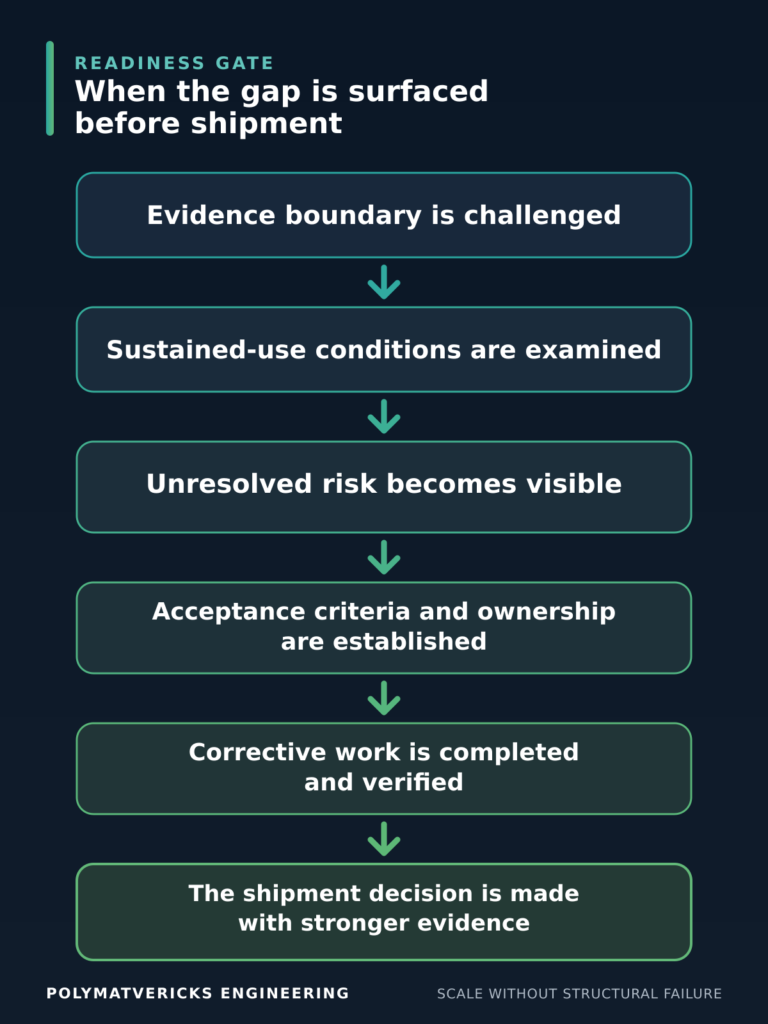
If the gap is surfaced before shipment, the path changes:
Evidence boundary is challenged → sustained-use conditions are examined → unresolved risk becomes visible → acceptance criteria and ownership are established → corrective work is completed and verified → the shipment decision is made with stronger evidence.
Polymatvericks Evidence Gate Cascade
The engineering issue may still require time and resources to resolve. But the company is addressing it before field exposure expands the consequences. That is the distinction our scale-readiness audit helps clients see, and our simulator was built to demonstrate.
A scale-readiness audit looks for the gaps, assumptions and dependencies that can otherwise become field failures. Because a gap found early is still a decision.
Disclaimer: This article is provided for general informational purposes only and does not constitute engineering, regulatory, legal, compliance, or other professional advice. References to external organizations, publications, products, or services do not imply endorsement or affiliation. Readers should evaluate requirements and risks based on their specific product, market, and circumstances.